Saturday, January 10, 2015
Walking itinery: Queen and Government
1. Hyde Park Corner Tube Station
2. Buckingham Palace Changing of the Guards
3. 17 Carlton House Terrace 1st Home of Napolean III
4. 1 Carlton Gardens 2d Home of Napolean III
5. 87 Jermyn St Home of Issac Newton 6. 13A Masons Yard Scotch Of St. James Pub
7. Picadilly Circus tube station: American Werewolf in London
8. 224 Picadilly Criterion Tavern
9. 198 Picadilly Home of Adam Worth (inspiration for Sir A.C. Doyle's Moriarity)
10. Carlton House Terrace & Waterloo Place - Duke of York column
11. Trafalgar Square Lord Nelson's column 12. Trafalgar Square London's smallest Police Station
13. St. Martin's in the Fields Church
14. Victoria Embankment 2d Scotland Yard location Norman Shaw Buildings
15. 4 Whitehall Place Old Scotland Yard
16. Whitehall, SW1 2ER Banqueting House
17. 10 Downing Street Prime Ministers House
18. Clive Steps, Churchill War Rooms
19. Big Ben
20. Parliament Square Statues (seen here, top to bottom, David Lloyd George, Abraham Lincoln, Nelson Mandela 21. Parliament House of Commons
22. Oliver Cromwell statute
23. 20 Deans Yard Westminister Abbey
24. 8 -10 Broadway New Scotland Yard
25. Victoria Station
Friday, January 9, 2015
Pussy Cat, pussy cat, where have you been?
"I've been to London to see the Queen."
A couple of things to think about BEFORE we go.
1. I will be notifying my credit card company, well in advance of our trip, the dates that I will be using my card in the United Kingdom. If you look on the back of your card there is a phone number. I would encourage you to call them several times to notify them of your plans. Since the British system uses a 'chip' and PIN code, this might, MIGHT, minimize inconveniences when you try to use your card in England and Scotland.
2. I will be purchases several hundred English Pounds (GBP) before we embark. At the time of this writing, the exchange rate is very favorable to the American traveler. Here is a site where you can keep an eye on the rate. Omaha's First National Bank at 114th & Dodge Street has walk-in services for exchange rates. Do not expect to receive the posted rate; however, it should be very close. You will notice that the One Pound is not a note, or bill, but is a rather thick coin with "edging."
3. Jet Lag can dampen your trip. Flying across several time zones can disrupt your internal clock (or circadian rhythms). In the past I have used a "sleep aid" to help me fall asleep on the flight from the USA to the UK. On my last trip I used Melatonin with limited results. While we have not booked the flights, in the past we left Chicago or Dallas at approximately 10 p.m. and arrived in London around 9 a.m. their time: which is 3 a.m. CST.
This day of our journal will begin at the home of QEII, or Queen Elizabeth's home, Buckingham Palace. We will try to arrive at, "The Buck" at ~10:15 in order to enjoy the Royal Pageantry of the changing of the guards. Since we'll want the best vantage, go here for additional input. In March, the changing of the guards occur on even dates.
Throughout history flags have had special meaning. In America we refer to our flag at "Old Glory" or the "Stars and Stripes." When the Queen is in-residence, her flag will fly over the palace. The flag we traditionally refer to as "The Union Jack" is actually an amalgamation of the individual country flags of the several of the nations that make up, 'The United Kingdom.' After the recent failed referendum for an independent Scotland, in which the Scottish people voted to remain a part of the United Kingdom, it may be appropriate, as well as sensitive to remember that England, Scotland, Wales and Norther Ireland, as well as several islands comprise the United Kingdom. In other words, please remember that Scotland is NOT England, and that it is a member of the United Kingdom. England is not synonymous with United Kingdom. Below is an interesting graphic which explains how the flag we know as the Union Jack is comprised, sorta...(I have not heard of any plans to add Wales to the Union Jack, contrary to this depiction).
One of iconic images of the Queen's home was the when Diana, Princess of Wales died tragically. As you may recall, since Diana and Prince Charles (the Queen's first son and heir to the Throne) were divorced, the Queen was reluctant to pay homage to the death of Diana: thereby elevating her societal rank in the monarchy. Eventually, after much delay and public outcry from the British citizens and her Prime Minister Tony Blair, the Queen and her husband Prince Phillip left their Scottish Estate and came to London for a public display of mourning to Ms. Spencer. As you can see from these photos, there was quite literally a massive wall of flowers placed voluntarily along the railing of Buckingham Palace by the people of England and the world.
Broadcast throughout the world, from Westminister Abbey (which we will visit today), it was at her funeral that Sir Elton John paid homage to the Princess by singing 'Candle in the Wind' with its modified lyrics. (Here)At the time these events occurred, I was working in the music industry. It is my recollection that the recording labels literally gave-away a cas-single of this song to record stores - to sell at a very low price - thus assuring that it replace Bing Crosby's 'White Christmas' as the best selling single in recorded music history.
To the EAST of Buckingham Palace is St. James Park and The Mall which leads to Trafalgar Square. (See today's interactive map here.)On the west end of the park you will be able to see a very small island. It is an interesting footnote that this island was recently inhabited by a stalker of the Queen. Robert Moore's skeleton was found on the island in 2008. While Moore did not pose a threat to Her Majesty, one can imagine that from his vantage point on the island, he spent many an evening gazing into the windows of the palace.
After the Changing of Guards, which begins at ~11 a.m. and last an hour, we might need to get a bite to eat. We'll do the proper thing and promenade down The Mall, past St. James' Palace (where Prince Charles and his second wife, Camilla 'The Duchess of Cornwall live), past the homes of Napoleon III of France. You may recall that after their wedding, Prince William (the first son of Diana and Charles) and his bride, Kate Middleton, drove slowly down the mall to the delight of those in attendance. (See here).
We'll next walk down Pall Mall, past the Duke of York's column, on our way to see the London home of Sir Issac Newton. You may recall that Newton is purported to have been sitting under his apple tree at Woolsthorpe Manor, Lincolnshire, when he "discovered" the theory of gravity.
We'll also be in the vicinity of the famed live music venue, Between, "1965-1980 - The Scotch of St. James was where, a then unknown, Jimi Hendrix first performed on the night of his arrival in England on 24 September 1966. It was on this night that Jimi met Kathy Etchingham who became his girl friend.On 19th of October 1966 the Jimi Hendrix Experience played their first UK gig as a private showcase at Scotch of St. James.The club was also where Paul McCartney first met Stevie Wonder, after the latter's live performance at the club on February 3, 1966."
During its heyday in the mid 1960's, the Beatles, the Rolling Stones, the Who, Rod Stewart,the Moody Blues, the Spencer Davis Group,[8] Eric Burdon, The Animals, Sonny and Cher, Inez and Charlie Foxx, Goldie and the Gingerbreads were regular patrons and The Beatles and Rolling Stones were given their own tables.In the mid 1980s the club was closed down.
2012-present day:
The club was restored and re-opened by a group of investors in January 2012.The new club is a fashionable night club frequented by the rich and famous,including fashion models such as Kate Moss,Suki Waterhouse,Cara Delevingne, Georgia Jagger, and Edie Campbell.The club has also attracted pop stars such as Harry Styles (One Direction)and Rita Ora. Other events hosted by the club include performances by musicians such as Miles Kane,Jack White (White Stripes), Mark Ronson, and John Legend. The club has also hosted parties for fashion houses including Stella McCartney (daughter of Sir Paul McCartney of the Beatles), J.W Anderson, Longchamp, Roger Vivier,Matthew Williamson, Linda Farrow, Rockins and Eyeko. Others who have held private parties at the club include Scarlett Johansson, Rihanna, Jack White, Dinos Chapman, Keira Knightley and Mark Ronson."
From here we'll mossie to the east to walk through Piccadilly Circus. As if the area's noted neon lights were not enough, many will recognize this location from various films including Mike Meyer's 'Austin Powers' or this scene from An American Werewolf in London.
Which brings us, somehow, to another discussion about Sherlock Holmes. Some believe that the character of Holmes was based upon the real-life Scotland Yard detective known as, 'Dick Tanner,,,of the Yard.' (IE: Bond, James Bond). What is know is that the character for Holmes' arch-rival, Moriarty,is based upon the American criminal Adam Worth a/k/a The Napoleon of Crime.' Worth was already an international criminal when he arrived in London in 1870. In 1874 the diminutive Worth (5'4") stole what was then the most expensive painting in the world, Gainsborough's Duchess of Devonshire.' Worth would be pursued but never apprehended by Scotland Yard's Chief Inspector John Shore. For more than two decades Worth keep the famed painting hidden between his mattress and bedsprings. Eventually he would sell the painting to raise monies for the release of his brother (who was released before the money was needed). Well after the fact,Worth formed a strong friendship with William Pinkerton (who had founded the Pinkerton Detectives). It was in the Criterion Pub in Piccadilly Circus that Worth shared with Pinkerton how he continually eluded and tricked CI Shore.Pinkerton would later share this with Arthur Conan Doyle, M.D. - who wrote the newspaper serial Sherlock Holmes. Worth's home was located at 198 Piccadilly.
From here we'll move south toward Trafalgar Square and to the Admiralty Arch, and into Trafalgar Square.
Today the Admiralty Arch is a luxury hotel. Interestingly, "On the inside wall of the northernmost arch is a small protrusion the size and shape of a human nose. It was placed there by artist Rick Buckley in 1997 as part of a campaign against the "Big Brother" society. The nose is at a height of about seven feet, and sits at waist height for anyone riding through the arch on a horse." This was a part of a London campaign by Buckley.
It is in Trafalgar Square that Lord Nelson's column and London's smallest Police station can be found. This location is featured in the third installment of the 'Night at the Museum' series.
The square is a commemoration of Nelson, a war hero, who died at the Battle of Trafalgar in 1805. At the base of the memorial are four great Lions, a symbol of the British Empire.
While we are in Trafalgar Square, located just northeast is St. Martin's in the Field church. Known worldwide for its classical music recordings; including the soundtrack to the popular film, 'Amadeus' (regarding the tragic life of Mozart), this church has hosted numerous luminaries for performances. It is also known for it's, "Cafe in the Crypts." Tea and biscuits anyone?? [SMITF Facebook Page]
From T-Square we'll walk towards the Thames River and the site of the original Scotland Yard. This reference to London's Metropolitan Police (a/k/a The Met) is a reference to the geographical location of the original police headquarters. The location was originally the home of the Kings of Scotland or 'Scotland Yard.' Since it's inception, 'The Yard' has moved two more times.
Members of the police force are known as "Bobbies." This name derives from a reference of the man who founded the police force, Robert Peel. Originally the role was to prevent crimes simply be being present. Eventually, and surreptitiously, Peel would allow the force to begin investigating crimes. Perhaps their most famous effort is the pursuit of Jack the Ripper. In his "letter from hell" the Ripper writes of eating a victim's kidney: a portion which was included in the letter.
From hell
Mr Lusk
Sor
I send you half the
Kidne I took from one women
prasarved it for you tother pirce
I fried and ate it was very nise I
may send you the bloody knif that
took it out if you only wate a whil
longer.
signed
Catch me when
you Can
Mishter Lusk
For more information on the purported letters from Jack the Ripper, go here.
For more specific information on Jack the Ripper, including an interactive map, go here.
An excellent map of the Ripper murders can be seen here.
From this location we'll move over to Whitehall Street - which is the home to the Administration of the British Government. This path will lead us past the 'Banquet House' where the Lord Protectorate Oliver Cromwell, who ruled England from 1653 until his death of natural causes in 1658. Although he ruled for a brief time, Cromwell signed and followed-through on the death certificate of the then King of England, Charles 1. The act of killing a king is known as "regicide." When Charles II came back to the throne, Cromwell's corpse was disinterred and beheaded. (See the Long Rock Walk for more details). The beheading of King Charles I occurred in the Banquet House. More on Cromwell here.
As a footnote, you may recall that Charles I was the "son" of the rumored pedophile King James I (a/k/a King James VI of Scotland and son of Mary Queen of Scots). In the motion picture 'Hook', Dustin Hoffman's character, Captain Hook the Pirate' was modeled upon King William III of England. (Charles III of England, is the son of the current Monarch, Queen Elizabeth II.)
Along this path we'll pass the home of England's Prime Minister, 10 Downing Street. It is akin to the American Presidential residence, our own White House.
Around the corner are the Churchill War Rooms where the then Prime Minister, conducted the British efforts against Germany in World War Two. Churchill's mother, Lady Randolph Churchill was an American named Jeanette 'Jennie' Jerome. Nickenamed 'Randy,' Mrs. Churchill's appetites included men other than her husband. (In U.K. the term 'randy' refers to an individual that readily desires sexual gratification a/k/a 'a real goer.')
From here it is a short jaunt to the second, and perhaps best known location for Scotland Yard. Today these are known as the Norman Shaw Buildings. The rock used to construct this Thames side building were quarried by convicts of the English penal system. This facility is located on the shore of the Thames River known as the Victoria Embankment.
(Lot's of things are named after England's currently longest serving Monarch, Queen Victoria (and husband Prince Albert). This is one of her many memorials, located outside of Buckingham Palace.
Here is a timeline for the lineage of the Monarch in England.
Although it's actual name is St. Stephen's Tower, the world knows it for the name of the clock that rests atop it, Big Ben.
For many, Big Ben is the iconic image that immediately comes to mind and associates London and England.It was constructed between 1843 - 1858 as a part of the then Westminster Palace.
Today the associated building is known as Parliament. Located within Parliament is the House of Commons - which is the legislative chambers of the British Government. Although American governance was strongly influenced by England's Parliament, in the English system the voters choose a party. The Prime Minister, who is the near equivalent of our President, is then chosen by the party. This means that their chief executive is never in the minority. Today (Jan. 2015), in the American system we have a divided government: where the President is from one party and both legislative branches are from the opposing party. Although their political system has as much intrigue and politics as our own, technically, the British system will not have a divided government.
To date, only one English Prime Minister has been assassinated. In 1812 Perceval would be shot at point-blank range in Parliament on his way to a debate in the House of Commons.
If you notice, the fourth name on this list of English Prime Minister's is Benjamin Disraeli. Yes, this is the name where the 2d album by rock's first "supergroup" Cream got the name for their album, Disraeli Gears (1967). The members of the band were Eric Clapton (guitar), Ginger Baker (drums) and Jack Bruce (bass). "The album features the two singles "Strange Brew" and "Sunshine of Your Love".The title of the album is based on a malapropism. Eric Clapton had been thinking of buying a racing bicycle and was discussing it with Ginger Baker, when a roadie named Mick Turner commented, "it's got them Disraeli Gears", meaning to say "derailleur gears", but instead alluding to 19th-century British Prime Minister, Benjamin Disraeli. The band thought this was hilarious, and decided that it should be the title of their next album.
The original 11-track album was remastered in 1998, and then subsequently released as a two-disc Deluxe Edition in 2004.
In 1999, the album was inducted into the Grammy Hall of Fame.
In 2003 the album was ranked No. 114 on Rolling Stone magazine's list of the 500 Greatest Albums of All Time. VH1 also named it their 87th greatest album of all time in 2001. In 2008, the album won a Classic Rock Roll of Honours Award for Classic Album. See a video of Clapton and Cream performing 'Strange Brew' here.
Today, many of us will recognize this mask. Our reference is either from the popular motion picture, 'Vendetta' or the cyber-hacking of the group, 'Anonymous.'
The mask is actually a depiction of the historical figure Guy Fawkes. It was during the reign of James I (son of Mary Queen of Scots) that, in 1605, Fawkes, as a member of the 'Gun Power Plot' attempted to blow up Parliament. The stem of these acts go back several generations to James' grandfather Henry VIII. It Henry's desire for a divorce from his first wife, Spain's Kathrine of Aragon, that, when the divorce was denied by The Pope in Rome, Henry threw the Roman church out of England and replaced the Pope - with himself as the head of the English Church. (Now known as the Church of England. In the USA we know this as the Anglican Church). When Henry ejected the Catholic Church and denied the authority of the Pope, it created great animosity between those formerly in power and the newly formed church. Such as the animosity that when his trusted aid, The Chancellor of England, Sir Thomas More refused to acknowledge Henry's new divorce, More would be forced to resign from Henry's government in 1532. Although the Monarch's Statute of Praemunire made it a crime to support the Pope in public or in office. Despite being a devout Catholic, More's friendship with Henry protected him...until he refused to attend the coronation of Henry's second wife, Anne Boleyn. Despite a congratulatory letter to the happy couple, More was prosecuted and eventually beheaded. As a footnote: were six burned at the stake for heresy during More's chancellorship: Thomas Hitton, Thomas Bilney, Richard Bayfield, John Tewkesbery, Thomas Dusgate, and James Bainham.
Henry's daughter Mary, would inherit the throne. Mary was an avid Catholic and re-instated the Church. Known as "Bloody Mary" her short time on the throne resulted in persecution of Protestants. Despite her misgivings, as she lay dying, Mary would instate her more tolerant sister, Elizabeth, to the throne. Initially QE1 was tolerant and supressed religious fighting in favor of relatively peaceful coexistence. However, Elizabeth's cousin, Mary Queen of Scots, (also referred to as Mary Stuart) was a threat since she was considered by English Catholics as having a legitimate claim to the throne. Mary's second husband was Lord Darnley: They were married in the Scottish Palace of Holyrood in Edinburgh. Darnley, like Mary, was the grandchild of Henry VIII's sister and had claim to the English throne. Despite his royal lineage, he was denied the role of co-Monarch of Scotland by Mary. Upset, he colluded with Scottish Protestant against his wife. He would later be found smothered in the castle garden.
Eventually, after uprisings by Catholics in northern England, and the marriage by Mary to a Protestant, and several alleged plots to conspire with Spain, Mary Queen of Scots would be executed. "At Fotheringhay on the evening of 7 February 1587, Mary was told that she was to be executed the next morning.She spent the last hours of her life in prayer, distributing her belongings to her household, and writing her will and a letter to the King of France.The scaffold that was erected in the Great Hall was two feet high and draped in black. It was reached by two or three steps and furnished with the block, a cushion for her to kneel on and three stools, for her and the Earls of Shrewsbury and Kent, who were there to witness the execution.The executioners (one named Bull and his assistant) knelt before her and asked forgiveness. She replied, "I forgive you with all my heart, for now, I hope, you shall make an end of all my troubles."Her servants, Jane Kennedy and Elizabeth Curle, and the executioners helped Mary to remove her outer garments, revealing a velvet petticoat and a pair of sleeves in crimson-brown, the liturgical colour of martyrdom in the Catholic Church...
Mary was not beheaded with a single strike. The first blow missed her neck and struck the back of her head. The second blow severed the neck, except for a small bit of sinew, which the executioner cut through using the axe. Afterward, he held her head aloft and declared, "God save the Queen." At that moment, the auburn tresses in his hand turned out to be a wig and the head fell to the ground, revealing that Mary had very short, grey hair. A small dog owned by the queen, a Skye terrier, is said to have been hiding among her skirts, unseen by the spectators. Following the beheading, it refused to be parted from its owner's body and was covered in her blood, until it was forcibly taken away and washed.Items supposedly worn or carried by Mary at her execution are of doubtful provenance; contemporary accounts state that all her clothing, the block, and everything touched by her blood was burnt in the fireplace of the Great Hall to obstruct relic-hunters.
When the news of the execution reached Elizabeth, she became indignant and asserted that Davison had disobeyed her instructions not to part with the warrant and that the Privy Council had acted without her authority. Elizabeth's vacillation and deliberately vague instructions gave her plausible deniability, to attempt to avoid the direct stain of Mary's blood.Davison was arrested, thrown into the Tower of London, and found guilty of misprision. He was released 19 months later.
Mary's request to be buried in France was refused by Elizabeth.Her body was embalmed and left unburied in a secure lead coffin until her burial, in a Protestant service, at Peterborough Cathedral in late July 1587. Her entrails, removed as part of the embalming process, were buried secretly within Fotheringay Castle.Her body was exhumed in 1612 when her son, King James VI and I, ordered that she be reinterred in Westminster Abbey, in a chapel opposite the tomb of Elizabeth I. In 1867, her tomb was opened to try to ascertain the resting place of James I; he was ultimately found with Henry VII, but many of her other descendants, including Elizabeth of Bohemia, Prince Rupert of the Rhine and the children of Anne, Queen of Great Britain, were interred in her vault."
As Elizabeth neared death, she would name Mary's son, King James VI of Scotland, a Protestant, to the throne. It was in this environment that Guy Fawkes would collude with other Catholics to assassinate King Charles I by placing explosives under Parliament. Fawkes would be discovered guarding the explosives and tortured into exposing the plot against the King.
Oliver Cromwell (outside Parliament).
Along with Mary Queen of Scots, others buried in Westminster Abbey include:
Charles Darwin (Theory of Evolution)
Oliver Cromwell, Anne of Cleves (Henry VIII), Neville Chamberlain, Chaucer, playwright Noel Coward, Charles Darwin, Charles Dickens, Disraeli, Edward I, Edward V, Edward the Confessor, Sir Edward Elgar, Elizabeth 1, King George 1, Edmond Halley (comet fame), Handel (Messiah), Thomas Hardy, James I (bible), Dr. Joule (physics), Dr. Kelvin, (physics), King Charles II, King Edward III, and VI, King Henry III, V, VII, King Richard (robin hood), Rudyard Kipling (The Jungle Book), David Livingston, George Lloyd, Henry Wadsworth Longfellow, John Milton, Issac Newton, Laurence Olivier, Purcell (music), Queen Mary (Henry VIII daughter), Queen Mary II, The Stuart family inc. Mary Queen of Scots Stuart, Plagnettes, Alfred Tennyson, Dylan Thomas (poet), and William of Orange.
From here, and I am running out of steam, we'll visit New Scotland Yard and the famous Black Museum, where the Met keeps and displays it criminal memorabilia. Unfortunately, the Black Museum, is private and by approved appointment only.
Finally, off to Victoria Station, where this tour ends.
Sources include: A view on Cities, London. Also, Wikipedia. Time Out London is also an excellent source. Downloadable 'Tourist Map of London.'
A couple of things to think about BEFORE we go.
1. I will be notifying my credit card company, well in advance of our trip, the dates that I will be using my card in the United Kingdom. If you look on the back of your card there is a phone number. I would encourage you to call them several times to notify them of your plans. Since the British system uses a 'chip' and PIN code, this might, MIGHT, minimize inconveniences when you try to use your card in England and Scotland.
2. I will be purchases several hundred English Pounds (GBP) before we embark. At the time of this writing, the exchange rate is very favorable to the American traveler. Here is a site where you can keep an eye on the rate. Omaha's First National Bank at 114th & Dodge Street has walk-in services for exchange rates. Do not expect to receive the posted rate; however, it should be very close. You will notice that the One Pound is not a note, or bill, but is a rather thick coin with "edging."
3. Jet Lag can dampen your trip. Flying across several time zones can disrupt your internal clock (or circadian rhythms). In the past I have used a "sleep aid" to help me fall asleep on the flight from the USA to the UK. On my last trip I used Melatonin with limited results. While we have not booked the flights, in the past we left Chicago or Dallas at approximately 10 p.m. and arrived in London around 9 a.m. their time: which is 3 a.m. CST.
This day of our journal will begin at the home of QEII, or Queen Elizabeth's home, Buckingham Palace. We will try to arrive at, "The Buck" at ~10:15 in order to enjoy the Royal Pageantry of the changing of the guards. Since we'll want the best vantage, go here for additional input. In March, the changing of the guards occur on even dates.
Throughout history flags have had special meaning. In America we refer to our flag at "Old Glory" or the "Stars and Stripes." When the Queen is in-residence, her flag will fly over the palace. The flag we traditionally refer to as "The Union Jack" is actually an amalgamation of the individual country flags of the several of the nations that make up, 'The United Kingdom.' After the recent failed referendum for an independent Scotland, in which the Scottish people voted to remain a part of the United Kingdom, it may be appropriate, as well as sensitive to remember that England, Scotland, Wales and Norther Ireland, as well as several islands comprise the United Kingdom. In other words, please remember that Scotland is NOT England, and that it is a member of the United Kingdom. England is not synonymous with United Kingdom. Below is an interesting graphic which explains how the flag we know as the Union Jack is comprised, sorta...(I have not heard of any plans to add Wales to the Union Jack, contrary to this depiction).
One of iconic images of the Queen's home was the when Diana, Princess of Wales died tragically. As you may recall, since Diana and Prince Charles (the Queen's first son and heir to the Throne) were divorced, the Queen was reluctant to pay homage to the death of Diana: thereby elevating her societal rank in the monarchy. Eventually, after much delay and public outcry from the British citizens and her Prime Minister Tony Blair, the Queen and her husband Prince Phillip left their Scottish Estate and came to London for a public display of mourning to Ms. Spencer. As you can see from these photos, there was quite literally a massive wall of flowers placed voluntarily along the railing of Buckingham Palace by the people of England and the world.
Broadcast throughout the world, from Westminister Abbey (which we will visit today), it was at her funeral that Sir Elton John paid homage to the Princess by singing 'Candle in the Wind' with its modified lyrics. (Here)At the time these events occurred, I was working in the music industry. It is my recollection that the recording labels literally gave-away a cas-single of this song to record stores - to sell at a very low price - thus assuring that it replace Bing Crosby's 'White Christmas' as the best selling single in recorded music history.
To the EAST of Buckingham Palace is St. James Park and The Mall which leads to Trafalgar Square. (See today's interactive map here.)On the west end of the park you will be able to see a very small island. It is an interesting footnote that this island was recently inhabited by a stalker of the Queen. Robert Moore's skeleton was found on the island in 2008. While Moore did not pose a threat to Her Majesty, one can imagine that from his vantage point on the island, he spent many an evening gazing into the windows of the palace.
After the Changing of Guards, which begins at ~11 a.m. and last an hour, we might need to get a bite to eat. We'll do the proper thing and promenade down The Mall, past St. James' Palace (where Prince Charles and his second wife, Camilla 'The Duchess of Cornwall live), past the homes of Napoleon III of France. You may recall that after their wedding, Prince William (the first son of Diana and Charles) and his bride, Kate Middleton, drove slowly down the mall to the delight of those in attendance. (See here).
We'll next walk down Pall Mall, past the Duke of York's column, on our way to see the London home of Sir Issac Newton. You may recall that Newton is purported to have been sitting under his apple tree at Woolsthorpe Manor, Lincolnshire, when he "discovered" the theory of gravity.
We'll also be in the vicinity of the famed live music venue, Between, "1965-1980 - The Scotch of St. James was where, a then unknown, Jimi Hendrix first performed on the night of his arrival in England on 24 September 1966. It was on this night that Jimi met Kathy Etchingham who became his girl friend.On 19th of October 1966 the Jimi Hendrix Experience played their first UK gig as a private showcase at Scotch of St. James.The club was also where Paul McCartney first met Stevie Wonder, after the latter's live performance at the club on February 3, 1966."
During its heyday in the mid 1960's, the Beatles, the Rolling Stones, the Who, Rod Stewart,the Moody Blues, the Spencer Davis Group,[8] Eric Burdon, The Animals, Sonny and Cher, Inez and Charlie Foxx, Goldie and the Gingerbreads were regular patrons and The Beatles and Rolling Stones were given their own tables.In the mid 1980s the club was closed down.
2012-present day:
The club was restored and re-opened by a group of investors in January 2012.The new club is a fashionable night club frequented by the rich and famous,including fashion models such as Kate Moss,Suki Waterhouse,Cara Delevingne, Georgia Jagger, and Edie Campbell.The club has also attracted pop stars such as Harry Styles (One Direction)and Rita Ora. Other events hosted by the club include performances by musicians such as Miles Kane,Jack White (White Stripes), Mark Ronson, and John Legend. The club has also hosted parties for fashion houses including Stella McCartney (daughter of Sir Paul McCartney of the Beatles), J.W Anderson, Longchamp, Roger Vivier,Matthew Williamson, Linda Farrow, Rockins and Eyeko. Others who have held private parties at the club include Scarlett Johansson, Rihanna, Jack White, Dinos Chapman, Keira Knightley and Mark Ronson."
From here we'll mossie to the east to walk through Piccadilly Circus. As if the area's noted neon lights were not enough, many will recognize this location from various films including Mike Meyer's 'Austin Powers' or this scene from An American Werewolf in London.
Which brings us, somehow, to another discussion about Sherlock Holmes. Some believe that the character of Holmes was based upon the real-life Scotland Yard detective known as, 'Dick Tanner,,,of the Yard.' (IE: Bond, James Bond). What is know is that the character for Holmes' arch-rival, Moriarty,is based upon the American criminal Adam Worth a/k/a The Napoleon of Crime.' Worth was already an international criminal when he arrived in London in 1870. In 1874 the diminutive Worth (5'4") stole what was then the most expensive painting in the world, Gainsborough's Duchess of Devonshire.' Worth would be pursued but never apprehended by Scotland Yard's Chief Inspector John Shore. For more than two decades Worth keep the famed painting hidden between his mattress and bedsprings. Eventually he would sell the painting to raise monies for the release of his brother (who was released before the money was needed). Well after the fact,Worth formed a strong friendship with William Pinkerton (who had founded the Pinkerton Detectives). It was in the Criterion Pub in Piccadilly Circus that Worth shared with Pinkerton how he continually eluded and tricked CI Shore.Pinkerton would later share this with Arthur Conan Doyle, M.D. - who wrote the newspaper serial Sherlock Holmes. Worth's home was located at 198 Piccadilly.
From here we'll move south toward Trafalgar Square and to the Admiralty Arch, and into Trafalgar Square.
Today the Admiralty Arch is a luxury hotel. Interestingly, "On the inside wall of the northernmost arch is a small protrusion the size and shape of a human nose. It was placed there by artist Rick Buckley in 1997 as part of a campaign against the "Big Brother" society. The nose is at a height of about seven feet, and sits at waist height for anyone riding through the arch on a horse." This was a part of a London campaign by Buckley.
It is in Trafalgar Square that Lord Nelson's column and London's smallest Police station can be found. This location is featured in the third installment of the 'Night at the Museum' series.
The square is a commemoration of Nelson, a war hero, who died at the Battle of Trafalgar in 1805. At the base of the memorial are four great Lions, a symbol of the British Empire.
While we are in Trafalgar Square, located just northeast is St. Martin's in the Field church. Known worldwide for its classical music recordings; including the soundtrack to the popular film, 'Amadeus' (regarding the tragic life of Mozart), this church has hosted numerous luminaries for performances. It is also known for it's, "Cafe in the Crypts." Tea and biscuits anyone?? [SMITF Facebook Page]
From T-Square we'll walk towards the Thames River and the site of the original Scotland Yard. This reference to London's Metropolitan Police (a/k/a The Met) is a reference to the geographical location of the original police headquarters. The location was originally the home of the Kings of Scotland or 'Scotland Yard.' Since it's inception, 'The Yard' has moved two more times.
Members of the police force are known as "Bobbies." This name derives from a reference of the man who founded the police force, Robert Peel. Originally the role was to prevent crimes simply be being present. Eventually, and surreptitiously, Peel would allow the force to begin investigating crimes. Perhaps their most famous effort is the pursuit of Jack the Ripper. In his "letter from hell" the Ripper writes of eating a victim's kidney: a portion which was included in the letter.
From hell
Mr Lusk
Sor
I send you half the
Kidne I took from one women
prasarved it for you tother pirce
I fried and ate it was very nise I
may send you the bloody knif that
took it out if you only wate a whil
longer.
signed
Catch me when
you Can
Mishter Lusk
For more information on the purported letters from Jack the Ripper, go here.
For more specific information on Jack the Ripper, including an interactive map, go here.
An excellent map of the Ripper murders can be seen here.
From this location we'll move over to Whitehall Street - which is the home to the Administration of the British Government. This path will lead us past the 'Banquet House' where the Lord Protectorate Oliver Cromwell, who ruled England from 1653 until his death of natural causes in 1658. Although he ruled for a brief time, Cromwell signed and followed-through on the death certificate of the then King of England, Charles 1. The act of killing a king is known as "regicide." When Charles II came back to the throne, Cromwell's corpse was disinterred and beheaded. (See the Long Rock Walk for more details). The beheading of King Charles I occurred in the Banquet House. More on Cromwell here.
As a footnote, you may recall that Charles I was the "son" of the rumored pedophile King James I (a/k/a King James VI of Scotland and son of Mary Queen of Scots). In the motion picture 'Hook', Dustin Hoffman's character, Captain Hook the Pirate' was modeled upon King William III of England. (Charles III of England, is the son of the current Monarch, Queen Elizabeth II.)
Along this path we'll pass the home of England's Prime Minister, 10 Downing Street. It is akin to the American Presidential residence, our own White House.
Around the corner are the Churchill War Rooms where the then Prime Minister, conducted the British efforts against Germany in World War Two. Churchill's mother, Lady Randolph Churchill was an American named Jeanette 'Jennie' Jerome. Nickenamed 'Randy,' Mrs. Churchill's appetites included men other than her husband. (In U.K. the term 'randy' refers to an individual that readily desires sexual gratification a/k/a 'a real goer.')
From here it is a short jaunt to the second, and perhaps best known location for Scotland Yard. Today these are known as the Norman Shaw Buildings. The rock used to construct this Thames side building were quarried by convicts of the English penal system. This facility is located on the shore of the Thames River known as the Victoria Embankment.
(Lot's of things are named after England's currently longest serving Monarch, Queen Victoria (and husband Prince Albert). This is one of her many memorials, located outside of Buckingham Palace.
Here is a timeline for the lineage of the Monarch in England.
Although it's actual name is St. Stephen's Tower, the world knows it for the name of the clock that rests atop it, Big Ben.
For many, Big Ben is the iconic image that immediately comes to mind and associates London and England.It was constructed between 1843 - 1858 as a part of the then Westminster Palace.
Today the associated building is known as Parliament. Located within Parliament is the House of Commons - which is the legislative chambers of the British Government. Although American governance was strongly influenced by England's Parliament, in the English system the voters choose a party. The Prime Minister, who is the near equivalent of our President, is then chosen by the party. This means that their chief executive is never in the minority. Today (Jan. 2015), in the American system we have a divided government: where the President is from one party and both legislative branches are from the opposing party. Although their political system has as much intrigue and politics as our own, technically, the British system will not have a divided government.
To date, only one English Prime Minister has been assassinated. In 1812 Perceval would be shot at point-blank range in Parliament on his way to a debate in the House of Commons.
If you notice, the fourth name on this list of English Prime Minister's is Benjamin Disraeli. Yes, this is the name where the 2d album by rock's first "supergroup" Cream got the name for their album, Disraeli Gears (1967). The members of the band were Eric Clapton (guitar), Ginger Baker (drums) and Jack Bruce (bass). "The album features the two singles "Strange Brew" and "Sunshine of Your Love".The title of the album is based on a malapropism. Eric Clapton had been thinking of buying a racing bicycle and was discussing it with Ginger Baker, when a roadie named Mick Turner commented, "it's got them Disraeli Gears", meaning to say "derailleur gears", but instead alluding to 19th-century British Prime Minister, Benjamin Disraeli. The band thought this was hilarious, and decided that it should be the title of their next album.
The original 11-track album was remastered in 1998, and then subsequently released as a two-disc Deluxe Edition in 2004.
In 1999, the album was inducted into the Grammy Hall of Fame.
In 2003 the album was ranked No. 114 on Rolling Stone magazine's list of the 500 Greatest Albums of All Time. VH1 also named it their 87th greatest album of all time in 2001. In 2008, the album won a Classic Rock Roll of Honours Award for Classic Album. See a video of Clapton and Cream performing 'Strange Brew' here.
Today, many of us will recognize this mask. Our reference is either from the popular motion picture, 'Vendetta' or the cyber-hacking of the group, 'Anonymous.'
The mask is actually a depiction of the historical figure Guy Fawkes. It was during the reign of James I (son of Mary Queen of Scots) that, in 1605, Fawkes, as a member of the 'Gun Power Plot' attempted to blow up Parliament. The stem of these acts go back several generations to James' grandfather Henry VIII. It Henry's desire for a divorce from his first wife, Spain's Kathrine of Aragon, that, when the divorce was denied by The Pope in Rome, Henry threw the Roman church out of England and replaced the Pope - with himself as the head of the English Church. (Now known as the Church of England. In the USA we know this as the Anglican Church). When Henry ejected the Catholic Church and denied the authority of the Pope, it created great animosity between those formerly in power and the newly formed church. Such as the animosity that when his trusted aid, The Chancellor of England, Sir Thomas More refused to acknowledge Henry's new divorce, More would be forced to resign from Henry's government in 1532. Although the Monarch's Statute of Praemunire made it a crime to support the Pope in public or in office. Despite being a devout Catholic, More's friendship with Henry protected him...until he refused to attend the coronation of Henry's second wife, Anne Boleyn. Despite a congratulatory letter to the happy couple, More was prosecuted and eventually beheaded. As a footnote: were six burned at the stake for heresy during More's chancellorship: Thomas Hitton, Thomas Bilney, Richard Bayfield, John Tewkesbery, Thomas Dusgate, and James Bainham.
Henry's daughter Mary, would inherit the throne. Mary was an avid Catholic and re-instated the Church. Known as "Bloody Mary" her short time on the throne resulted in persecution of Protestants. Despite her misgivings, as she lay dying, Mary would instate her more tolerant sister, Elizabeth, to the throne. Initially QE1 was tolerant and supressed religious fighting in favor of relatively peaceful coexistence. However, Elizabeth's cousin, Mary Queen of Scots, (also referred to as Mary Stuart) was a threat since she was considered by English Catholics as having a legitimate claim to the throne. Mary's second husband was Lord Darnley: They were married in the Scottish Palace of Holyrood in Edinburgh. Darnley, like Mary, was the grandchild of Henry VIII's sister and had claim to the English throne. Despite his royal lineage, he was denied the role of co-Monarch of Scotland by Mary. Upset, he colluded with Scottish Protestant against his wife. He would later be found smothered in the castle garden.
Eventually, after uprisings by Catholics in northern England, and the marriage by Mary to a Protestant, and several alleged plots to conspire with Spain, Mary Queen of Scots would be executed. "At Fotheringhay on the evening of 7 February 1587, Mary was told that she was to be executed the next morning.She spent the last hours of her life in prayer, distributing her belongings to her household, and writing her will and a letter to the King of France.The scaffold that was erected in the Great Hall was two feet high and draped in black. It was reached by two or three steps and furnished with the block, a cushion for her to kneel on and three stools, for her and the Earls of Shrewsbury and Kent, who were there to witness the execution.The executioners (one named Bull and his assistant) knelt before her and asked forgiveness. She replied, "I forgive you with all my heart, for now, I hope, you shall make an end of all my troubles."Her servants, Jane Kennedy and Elizabeth Curle, and the executioners helped Mary to remove her outer garments, revealing a velvet petticoat and a pair of sleeves in crimson-brown, the liturgical colour of martyrdom in the Catholic Church...
Mary was not beheaded with a single strike. The first blow missed her neck and struck the back of her head. The second blow severed the neck, except for a small bit of sinew, which the executioner cut through using the axe. Afterward, he held her head aloft and declared, "God save the Queen." At that moment, the auburn tresses in his hand turned out to be a wig and the head fell to the ground, revealing that Mary had very short, grey hair. A small dog owned by the queen, a Skye terrier, is said to have been hiding among her skirts, unseen by the spectators. Following the beheading, it refused to be parted from its owner's body and was covered in her blood, until it was forcibly taken away and washed.Items supposedly worn or carried by Mary at her execution are of doubtful provenance; contemporary accounts state that all her clothing, the block, and everything touched by her blood was burnt in the fireplace of the Great Hall to obstruct relic-hunters.
When the news of the execution reached Elizabeth, she became indignant and asserted that Davison had disobeyed her instructions not to part with the warrant and that the Privy Council had acted without her authority. Elizabeth's vacillation and deliberately vague instructions gave her plausible deniability, to attempt to avoid the direct stain of Mary's blood.Davison was arrested, thrown into the Tower of London, and found guilty of misprision. He was released 19 months later.
Mary's request to be buried in France was refused by Elizabeth.Her body was embalmed and left unburied in a secure lead coffin until her burial, in a Protestant service, at Peterborough Cathedral in late July 1587. Her entrails, removed as part of the embalming process, were buried secretly within Fotheringay Castle.Her body was exhumed in 1612 when her son, King James VI and I, ordered that she be reinterred in Westminster Abbey, in a chapel opposite the tomb of Elizabeth I. In 1867, her tomb was opened to try to ascertain the resting place of James I; he was ultimately found with Henry VII, but many of her other descendants, including Elizabeth of Bohemia, Prince Rupert of the Rhine and the children of Anne, Queen of Great Britain, were interred in her vault."
As Elizabeth neared death, she would name Mary's son, King James VI of Scotland, a Protestant, to the throne. It was in this environment that Guy Fawkes would collude with other Catholics to assassinate King Charles I by placing explosives under Parliament. Fawkes would be discovered guarding the explosives and tortured into exposing the plot against the King.
Oliver Cromwell (outside Parliament).
Along with Mary Queen of Scots, others buried in Westminster Abbey include:
Charles Darwin (Theory of Evolution)
Oliver Cromwell, Anne of Cleves (Henry VIII), Neville Chamberlain, Chaucer, playwright Noel Coward, Charles Darwin, Charles Dickens, Disraeli, Edward I, Edward V, Edward the Confessor, Sir Edward Elgar, Elizabeth 1, King George 1, Edmond Halley (comet fame), Handel (Messiah), Thomas Hardy, James I (bible), Dr. Joule (physics), Dr. Kelvin, (physics), King Charles II, King Edward III, and VI, King Henry III, V, VII, King Richard (robin hood), Rudyard Kipling (The Jungle Book), David Livingston, George Lloyd, Henry Wadsworth Longfellow, John Milton, Issac Newton, Laurence Olivier, Purcell (music), Queen Mary (Henry VIII daughter), Queen Mary II, The Stuart family inc. Mary Queen of Scots Stuart, Plagnettes, Alfred Tennyson, Dylan Thomas (poet), and William of Orange.
From here, and I am running out of steam, we'll visit New Scotland Yard and the famous Black Museum, where the Met keeps and displays it criminal memorabilia. Unfortunately, the Black Museum, is private and by approved appointment only.
Finally, off to Victoria Station, where this tour ends.
Sources include: A view on Cities, London. Also, Wikipedia. Time Out London is also an excellent source. Downloadable 'Tourist Map of London.'
Monday, January 5, 2015
Newcastle Walk itenary (subject to change)
1. St. Nicholas Cathedral, St. Nicholas Square
2. Vampire Rabbit, St. Nicholas Square
3. Morden Tower Back, Stowell Street
4. Dog Leap Stairs, Side (Castle Garth), Newcastle upon Tyne, Newcastle upon Tyne, NE1 1RQ
5. The Black Gate and Castle Keep
6. Quayside, Wesley Square
7. Club Go Go, Eldon Garden Shopping Mall, Percy Street
8. Hotspur Façade, 43-45 northumberland street
9. John Wesley Orphanage, 49-53 Northumberland St.
10. Newcastle City Hall, Northumberland Road & College Street
11. Charles Dickens reading, corner of Nelson & Grainger St
12. Northumbria University
13. Bryan Ferry college home, Islington Terrace
14. Beatles Hotel, Jesmond Road, NE2 1PR
15. St. Mary's Chapel and Well, 68 Reid Park Road
16. Jesmond Dene
17. Chas Chander house, 35 Second Avenue
18. Mark Knopfler's childhood home, 23-24 Wheatfield Grove
19. Jimi Hendrix buskers (or not), Chillingham Road
20. Sting home, 82 Station Rd,
21. Balmbra's Pub, 5 Cloth Market
22. 31-33 Marondale Avenue (Eric Burdon)
Note: to access all the postings for this site, please see the highlighted links on the upper right side.
Saturday, January 3, 2015
"It's the Walk of Life" in Newcastle Upon Tyne
A relatively small town of 266,000 people, Newcastle Upon Tyne (as in Tyne River) is best the perhaps kept secret in the Rock World!
Here's how one person responded..."Whooaaaa!!!! Had no idea all that was happening from there!! That's so so cool. and Jimi and Summers too! whoaa so cool thanks!"
Perhaps best known in America for the phrase, "taking coals to Newcastle." This city in the Northeast of England was immortalized for many in the Dream Academy song, 'Life in a Northern Town' (watch here.) Note: St. Nicholas Cathedral towards the end of the video. Culturally the city is also known for its vibrant music scene, launching many of the world's largest music acts during the 1980's as well as being the hometown of two of the movie industry's most acclaimed film directors.
The area is also known, perhaps indirectly, for it's religious ministers, including John Knox (more below), as well as ushering in the birth of the Methodist Church. Founded by John Wesley and his brother Charles, along with noted evangelical George Whitfield, Methodism is the largest Mainline Protestant faith in the United States. An Oxford man, Wesley's "Aldersgate experience" ignited his religious fervency which is known for itinerant ministers or circuit riders, the use of lay-minister (or members of the congregation), massive outdoor revivals, and a methodological approach to reading and practicing the Bible.
Minister and religious firebrand, John Knox
Although he had visited and preached in the pre-Revolutionary America,John Wesley's first sermon occurred on the Quayside of the Tyne River...a site we'll visit on our walking tour of Newcastle.
This Quayside obelisk marks the spot of Wesley's first sermon
Here is a tentative map of the sites we'll visit in the Newcastle area.
Home to the legendary Newcastle United Football Club, Newcastle was a Roman settlement called Pons Aelius. The Roman garrison was located at the eastern end of Hadrian's Wall - a wall which extended across northern England: designed to keep the Scots and Picks from invaded the then Roman territory. This is depicted in the 2011 film, 'The Eagle' (which can be viewed on Netflix.).
The wall is also featured in the Kevin Costner film 'Robin Hood.' Watch the scene here.
The actual scene from the movie can be seen here.
For more on the wall and Housesteads, go here.
Near Newcastle is the village of Alnwick...home of the Earl of Northumberland. The castle is the site of many films you will probably know including the famous scene where Harry Potter learns to fly his broomstick, here.
2002 - Harry Potter and the Chamber of Secrets
2001 - Harry Potter and the Philosopher's Stone
1998 - Elizabeth - Starring Cate Blanchett, and Geoffrey Rush, here.
1991 - Robin Hood Prince of Thieves - Starring Kevin Costner and Alan Rickman (More here)
1982 - Ivanhoe - Starring Anthony Andrews and James Mason; directed by Douglas Camfield
1979 - The Spaceman and King Arthur
1971 - Mary, Queen of Scots - Starring Vanessa Redgrave and Glenda Jackson
1964 - Becket - Starring Richard Burton and Peter O’Toole (Available on Netflix)
More movie scene film fun HERE!
The residents of the Newcastle area are known as Geordies. What does it mean? No one seems to know. "ONE theory is that the name was taken from George (Geordie) Stephenson, the mining and railway engineer who hailed from the north-east. Another is that it derives from a term of abuse coined by the Scottish Jacobites in the 1745 Rebellion because of the defense of the town of Newcastle against them by supporters of King George (Geordie) II. The second theory is more plausible because the term Geordie is properly used for natives of Newcastle only. Others originating from the north-east are Tynesiders (from the towns along the Tyne, from Blaydon and Newburn downstream), Northumbrians, Durhamites (Dunhelmians if you are posh) or Makems (from Sunderland). Stephenson, born in Wylam, Northumberland, was not a Geordie except as a corruption of his Christian name."
Americans will notice immediately that there is a dramatic difference between the accents we hear on PBS Television or heard in London, who, by the way, are known as Cockneys. Geordie slang is not easy to understand. However, to help you translate, here is a website of "official slang" which is certain to put a smile on your face. I've also found a site where you can translate words and phrases INTO Geordie slang - which ought to provide hours of cheap entertainment.And, as an honorary Geordie for more than 35 years, I can usually translate if necessary!
Here is a funny video, of an easy to understand young Geordie couple on a visit from Newcastle to London. Or you can watch this somewhat hilarious video and "larn ta speak Geordie here."
Brian Johnson, lead singer of AC/DC, is from the Newcastle area (Dunston, Gateshead). Before joining the band to record their multi-platinum hit album, 'Back in Black' (an homage to the death of the previous lead singer, Bon Scott), Johnson's earlier but well-known band's was named, 'Geordie.'
This area of England is known for coal mining and ship building. In the 1980's, two of the largest figures in pop music hailed from the Tyneside area: Sting (Police) and Mark Knopfler (Dire Straits). Other significant music figures from this area of England include: Dave Stewart (Eurythmics, watch), Brian Johnson (AC/DC, watch), Bryan Ferry and Roxy Music, Andy Tayor (Duran, Duran, watch), Neil Tenant (Pet Shop Boys, watch), The Animals (Watch:House of the Rising Sun) featuring Chas Chandler, Alan Price, Hilton Valentine and Eric Burdon, and the hard rock band, Satan (watch).
As a footnote, the guitarist for the Police, Andy Summers, was a member of the Newcastle based band, The Animals, prior to becoming a founding member of the Police. Legend has it, Summer's was also among the first to play with Seattle's Jimi Hendrix when Hendrix first arrived in the United Kingdom. Hear them play together here.
Hear Dire Strait's 'Sultans of Swing' here.
Both Sting and Mark Knopfler would lean heavily on their lives in Newcastle in their music.
Sting's album, Soul Cages, released 1991 (hear it.)was written after the death of the singer's father. Although Gordon Sumner's father was a milkman, and not a shipbuilder, the families customers were workclass residents in the city of Wallsend: which is, as the name suggests, where Hadrian's wall ended.
Billy was born within sight of the shipyard
First son of a riveter's son
And Billy was raised as the ship grew a shadow
Her great hull would blot out the light of the sun
And six days a week he would watch his poor father
A working man live like a slave
He'd drink every night and he'd dream of a future,
Of money he never would save
And Billy would cry when he thought of the future
Soon came a day when the bottle was broken
They launched the great ship out to sea
He felt he'd been left on a desolate shore
To a future he desperately wanted to flee
What else was there for a shipbuilder's son
A new ship to be built, new work to be done
One day he dreamed of the ship in the world
It would carry his father and he
To a place they would never be found
To a place far away from this town.
Trapped in the cage of the skeleton ship
All the workmen suspended like flies
Caught in the flare of acetylene light
A working man works till the industry dies
And Billy would cry when he thought if the future
Then what they call an industrial accident
Crushed those it couldn't forgive
They brought Billy's father back home in an ambulance
A brass watch, a cheque, maybe three weeks to live,
And what else was there for a riveter's son
A new ship to be built, new work to be done
That night, he dreamed of the ship in the world
It would carry his father and he
To a place they could never be found
To a place far away from this town,
A Newcastle ship without coals
They would sail to the island of souls.
Sting's most recent album, The Last Ship, is a staged performance, or musical. Like many of Sting's semi-autobiographical work, this album also revolves around the lives of ordinary people and the shipbuilding industry. See the entire performance here (from PBS or the Public Broadcasting System.)
As a solo artist Mark Knopfler also sang about his Northumberland home. In this instance using a well known phrase which people from the area, known as Geordies, use...Why Aye Man! (Hear it.)Knopfler references the late 70's when the ship building industry collapsed and economic hardship, redundancy and a general dislike for the economic conservative Prime Minister Margaret "Maggie" Thatcher were evident. (Which would later be captured in an Oscar winning performance for American Meryl Streep in "The Iron Lady."
We had no way of staying afloat,
We had to leave on a ferryboat.
Economic refugees,
On the run to Germany.
We had the back of Maggie's hand,
Times were tough in Geordieland.
We got wor tools and working gear
And humped it all from Newcastle to here.
Why aye man.
Why aye, why aye man.
Why aye man,
Etc...
We're nomad tribes, travelling boys,
In the dust and dirt and the racket and the noise.
Drills and hammers, diggers and picks,
Mixing concrete, laying bricks.
There's English, Irish, Scots, the lot.
United Nations' what we've got.
Brickies, chippies, every trade.
German building, British made.
Why aye man.
Why aye, why aye man.
Etc...
Nay more work on Maggie's farm.
Haddaway down the autobahn.
Mine's a Portakabin bed,
Or a bunk in a Nissen hut instead.
There's plenty Deutschmarks here to earn.
And German tarts are wunderschön.
German beer is chemical free.
Germany's alright with me.
Sometimes I miss my river Tyne,
But you're my pretty fräulein.
Tonight we'll drink the old town dry,
Keep wor spirit levels high.
Why aye man.
Why aye, why aye man.
Etc..
Sometimes I miss my river Tyne,
But you're my pretty fräulein.
Tonight we'll drink the old town dry,
Keep wor spirit levels high.
Noted band, the Animals sang American blues but came from Newcastle. Perhaps best known for their rendition of the Leadbelly/ traditional song, 'House of the Rising Sun, Eric Burdon, who later teamed up with the multi-racial band War, was born in 31 Marondale Avenue.
The city was also the backdrop for the 1988 film, 'Stormy Monday' which featured Meg Griffith, Sting and Tommy Lee Jones. (See the trailer here.)
The 2006 inspirational film, 'Goal, The Dream Begins'also uses the city and its beloved NUFC as a backdrop. (See the trailer here.) Watch the full length film, 'Goal' here.
Film Directors and brother's Tony Scott and Ridley Scott were born in this area of England to a military family.
Tony Scott with Tom Cruise in the filming of 'Top Gun.'
An edited list of films by Director Tony Scott
Beverly Hills Cop II
Crimson Tide
Days of Thunder
Enemy of the State
The Hunger (1983
The Last Boy Scout
Man on Fire (2004)
The Taking of Pelham 123 (2009)
Top Gun
True Romance
Unstoppable (2010)
Tony Scott died in 2012
Ridley Scott with Harrison Ford (Star Wars, Indiana Jones) in the filming of 'Blade Runner.'
An edited list of films by Director Ridley Scott
Alien
Blade Runner
Legend
Someone to Watch Over Me
Black Rain
Thelma & Louise
1492: Conquest of Paradise
G.I. Jane
Gladiator
Hannibal
Black Hawk Down
Kingdom of Heaven
American Gangster
Body of Lies
Robin Hood
Prometheus
The Counselor
Our "Walk of Life" begins at St. Nicholas Cathedral. Which, indirectly, played a role in the creation of the King James Bible...
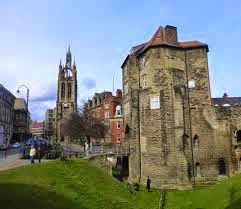
St. Nick's, seen here behind the famed 'Black Gate' of the Newcastle city walls, was the home of famed Protestant Minister John Knox - who famously pestered the cousin of England's Queen Elizabeth 1, Mary Queen of Scots. Mary's son, King James VI of Scotland, would become the king of England and commission the 'King James Bible.' Mary would be beheaded for her alleged involvement in the conspiracy to dethrone Elizabeth. Here is an embellished death mask of Mary Queen of Scots. Here is a Monty Python skit on the death of Mary Queen of Scots.
Elizabeth 1 - Queen of England
Henry VIII - father of Elizabeth and Uncle to Mary, Queen of Scots
You will see his "advertising" suit of Armour in the White Tower at the Tower of London. We will also visit his grave site at Windsor Castle.
St. Nicolas is also the home to the mysterious 'Vampire Rabbit.'
The Vampire Rabbit is a bizarre decoration on the façade of the Cathedral Buildings in Newcastle Upon Tyne. The grotesque fanged apparition can be found above an ornate doorway at the rear of the building
From the home of the vampire rabbit and John Knox we'll walk the short distance to the 'castle' in Newcastle. Founded by Robert Curthose who was the son of William the Conquer in 1066, Newcastle was built as a northern anchor to the kingdom of the Norman King.
From the Keep we traverse down the Dog Leap Stairs - which are referenced on the 1978 Dire Staits debut album, in the song, 'Waterline.' Watch it here.
"Sweet surrender on the quayside
You remember we used to run and hide
In the shadow of the cargoes I take you one at a time
And we're counting all the numbers down to the waterline
Near misses on the dogleap stairways
French kisses in the darkened doorways
A foghorn blowing out wild and cold
A policeman shines a light upon my shoulder
Up comes a coaster fast and silent in the night
Over my shoulder all you can see are the pilot lights
No money in our jackets and our jeans are torn
Your hands are cold but your lips are warm
She can see him on the jetty where they used to go
She can feel him in the places where the sailors go
When she's walking by the river and the railway line, She can still hear him whisper,
Let's go down to the waterline"
The Quayside,or "waterline," featuring the famed 'Newcastle Bridge' and, in the distance, the more current Millennium Bridge.
From the Quayside, we'll hike back up Pilgrim Street to stop at the site of the former Club Go-Go, where Sting witnessed a pre-London Jimi Hendrix perform.
Newcastle-Upon-Tyne, "Club A' Go Go", Northumberland
Concert (two shows between 20:00 and 02:00).
"The first gig of the Jimi Hendrix Experience in Newcastle took place at the Club A Go Go on Percy Street on 10th march 1967. The bands fee for the evening was £250 .There were two shows, one at 8pm in the under 18s room called the "Young Set" and a later show at 2pm in the "Jazz Lounge". There was no support band. During the show in the "Young Set" Jimi put his guitar through the low ceiling and made a hole in it. He had done this a month earlier at the New Cellar Club in South Shields and he repeated the stunt at the Club A Go Go. Here it was definately a deliberate act and witnesses watched in amazement as Jimi rammed the headstock through the plasterboard. Newcastle-Upon-Tyne, "Club A' Go Go", Northumberland
North East based actor/singer Jimmy Nail said: " I was in my mid-teens and used to go to the Club A Go Go which had a very low ceiling. Hendrix - I hadn't seen anything like it - leapt with the guitar and it went through a ceiling tile. But get this, he let it go and continued playing while it hung from the ceiling."
Sting said in his autobiography: "The Jimi Hendrix Experience was an overwhelming, deafening wave of sound that simply obliterated analysis. I think I remember snatches of ‘Hey Joe’ and ‘Foxy Lady’, but that event remains a blur of noise and breathtaking virtuosity, of Afro’d hair, wild clothes, and towers of Marshall amplifiers. I remember Hendrix creating a hole in the plaster ceiling above the stage with the head of his guitar, and then it was over. I lay in my bed that night with my ears ringing and my worldview significantly altered."
Club A Go Go regular Bill Chesters remembers: "I only saw the gig in the Young Set. I didn't look old enough to blag my way into the Jazz Lounge until a good while later when I got to know the doormen. You paid extra for the two venues, they were both open simultaneously, and you got a fluorescent mark on your hand which allowed you into the Jazz Lounge. We used to pay for the Young Set and drop the doorman a couple of bob for him to put the "mark" on! With regards to the actual Hendrix gig, I can't remember much about it other than it wasn't full. I also spotted him using his hand to pluck his guitar strings when he was supposed to be playing it with his teeth!!! And I recall his curly hair being full of plaster dust when he put his guitar through the ceiling! "
Audience member Colin Hart said: "I remember Jimi's guitar being stuck in the ceiling at Newcastle. He did continue to run his fingers all over it as it hung there. He left it hanging when he left the stage and it was quickly retrieved before any fans got THE souvenir of a lifetime. The Newcastle gig wasn't totally packed, but it was jammed up the front where I was."
Ron Seymour was also at the show: "I seem to remember that Hendrix played two sets in The Young Set and there was some dispute as to whether he was going to play in The Jazz Lounge. I wasn’t old enough to get into the Jazz Lounge and left after the Young Set show so I don’t know what eventually happened. I had always thought that he played both his sets in the Young Set and didn’t play in the Jazz Lounge but I could be wrong. I also remember there was a guy called Tommy who worked on the fruit barrows in the Grainger Market, who was a bit of a feature at the club and who regularly used to get up and dance on stage with the acts. He got onto the stage during Hendrix’s show and was promptly flung into the audience by one of the roadies."
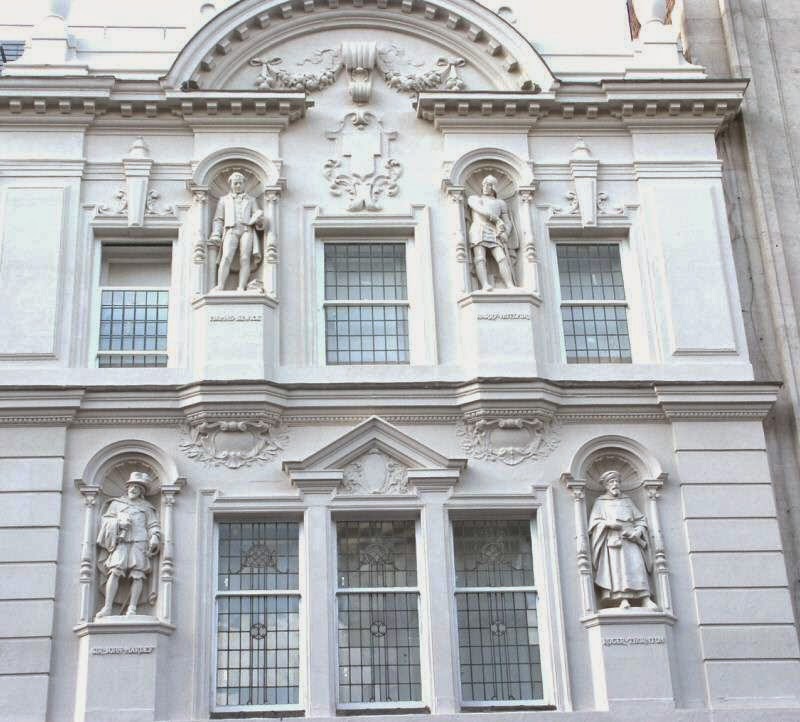
From there we'll move around the corner to see a marvelous albeit usually ignore historic facade which includes notable historic figures from the area's past including:
Top Left - Thomas Bewick (1755-1828) was an iinternationally renowned artist, wood engraver and ornithologist who spent most of his working life in Newcastle. More here - Thomas Bewick.
Top Right - Sir Henry Percy (1366-1403), who, because of his ferocity in combat, was known as Harry Hotspur. He fought in several campaigns against the Scots and the French. More here - Sir Henry Percy
Bottom Left - Sir John Marley (1590-1673) defended Newcastle against the Scots army in 1644. He also served as the mayor of Newcastle after the Civil War and Restoration.
Bottom Right - Roger Thornton (Died around 1429) rose from rags to riches, making his fortune as a merchant. He later became the mayor of Newcastle 3 times and an MP. More here - Roger Thornton
Just north and west of the downtown area is the University of Newcastle where Bryan Ferry and noted comedic actor Rowan Atkinson attended.
Provided we have the time and inclination, is the Imperial Hotel (now Holiday Inn) on Jesmond Street where legend has it the Beatles wrote their hit song, "She Loves You, yeah...yeah...yeah."
"She Loves You" is a song written by John Lennon and Paul McCartney and recorded by English rock group the Beatles for release as a single in 1963. The single set and surpassed several records in the United Kingdom charts, and set a record in the United States as one of the five Beatles songs that held the top five positions in the American charts simultaneously on 4 April 1964. It is their best-selling single in the United Kingdom, and was the best selling single there in 1963.
In November 2004, Rolling Stone ranked "She Loves You" number 64 on their list of the 500 Greatest Songs of All Time. In August 2009, at the end of its "Beatles Weekend", BBC Radio 2 announced that "She Loves You" was the Beatles' all-time best-selling single in the UK based on information compiled by The Official Charts Company.
Lennon and McCartney started composing "She Loves You" after a 26 June 1963 concert at the Majestic Ballroom in Newcastle upon Tyne during their tour with Roy Orbison and Gerry and the Pacemakers. They began writing the song on the tour bus, and continued later that night at their hotel in Newcastle.
In 2000, McCartney said it began with Bobby Rydell's song "Forget Him" and the call and response pattern, and that "as often happens, you think of one song when you write another ... I'd planned an 'answering song' where a couple of us would sing 'she loves you' and the other ones would answer 'yeah yeah'. We decided that was a crummy idea but at least we then had the idea of a song called 'She Loves You'. So we sat in the hotel bedroom for a few hours and wrote it—John and I, sitting on twin beds with guitars."
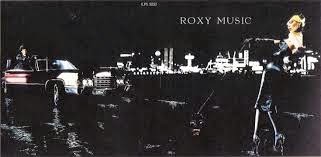
Along the way is the former University home of Roxy Music frontman Bryan Ferry. Always suave and debonair, neither Ferry's solo career and his career with the band have managed the devout following and admiration that English fans, including David Bowie has lent the band. Bowie describes Ferry as among the most cerebral lyricists in rock. Among their stateside hits is, 'Love is the Drug.' See it here. Ferry's latest solo effort, Avonmore was reviewed recently on National Public Radio's All Things Considered. A really personal homage to the pre-Roxy Music era Bryan Ferry can be found (City of Washington) here and (University) here.
St.Mary's Chapel and St. Mary's Well
The following is taken from "An Account of Jesmond" by F.W. Dendy, 1903.
"A site of particular historical interest in Jesmond are the ruins of St.Mary's Chapel near the junction of Reid Park Road and Jesmond Dene Road, and St. Mary's Well nearby on the footpath behind Grosvenor Road.
According to local legend, sometime after the Norman conquest, an apparition of the blessed virgin Mary (presumably holding the baby Jesus, hence the place name) appeared at what is now known as St Mary’s rock in Jesmond Dene; an enchanting, enigmatic spot adjacent to Ridley Mill and well worth a visit at any time of year.
St. Mary's Chapel at "Jesu Mount" was regarded as one of the most important shrines in Christendom in medieval times. The reason for this veneration was due to the fact that evidence of the enactment of healing miracles at St. Mary's Well had been received and accepted by the Pope in Rome. It was held that Jesus, at the request of the Virgin Mary, had performed miracles between AD 1125 and AD 1250 at the Well, which was in a wooded hollow, a short distance to the west of the Chapel.
The Chapel was originally built in the middle of the 12th century. It has been suggested that the Lords of Jesmond brought relics from the Holy Land to the Chapel which caused it to become the object of pilgrimages. Pilgrim Street in the City Centre is so named because the pilgrims would lodge there on their way to St. Mary's at Jesmond.
In 1428 the Chapel was partly ruined and Pope Martin requested that it should be repaired. The shrine became so important that up to 1449 presentations were made to it by the King of England.
In 1548 the Chapel was suppressed by Edward VI. It was sold to the mayor of Newcastle in 1549 who then sold it to John Brandling, Squire of Jesmond. The Chapel was disendowed, dismantled, and put to secular uses, finally becoming a barn and stable. It fell into ruin and in 1883 the plot of ground on which it stood, about one acre, was given by Lord Armstrong as part of his gift of Jesmond Dene to Newcastle for a public park.
Although the Chapel is in ruin with wild plants growing inside and has no roof, it is still a popular place with many people who appreciate the tranquility of the site. A few faithful worshipers meet regularly to pray and maintain the neat and tidy condition of the site."
The water in St. Mary's Well was reputed to have healing properties - drawing pilgrims from across Europe to bath in its waters.
More information on this sacred site can be found in two locations. Here and Here.
From here we will need to jump in a van and visit the homes of Chas Chandler, where, as his manager, Chandler housed Jimi Hendrix for a brief time.
This tenure resulted in the rumor that Hendrix was seen busking on Chillingham Road in the 1960's.
We'll also go the childhood neighborhood of Dire Strait's founder Mark Knoplfer where he and his fellow band mate, and brother,David Knoplfer grew up.
Finally, we'll venture to Wallsend. We'll pause at the site of the upstairs flat where Gordon 'Sting' Sumner grew-up, the son of a milkman.
Prior to founding the Police, Sting performed around, 'The Toon' and played a variety of musical genres. Here is a jazz performance by the Newcastle Big Band (hear).
Sting is the fifth from the left, near the doorway. More on the Newcastle Big Band here.
As a footnote: When Sting grew up in Newcastle - it was an damp industrial town. I lived there in '75 and '80 for a year each time...it was a tough town much like Detroit or Pittsburgh. When we were married in 1991, I took my wife there, to visit friends,on our honeymoon.
Year's later my wife got to meet Sting when he was in town.When she told him I'd taken her there after our wedding he laughed out loud, called his manager over and said,"That's like going to Milwaukee!"
I doubt he remembers Barb but I'll bet money he remembers the gal that got taken to Newcastle for her Honeymoon!
Wallsend is also the home of 'Satan' guitarist, and my friend, Russ Tippins: whom we'll try to arrange to meet if he's not out touring.
(See and Hear it here.)
Sources include the Explore Heritage plaque website. Newcastle Photos blogspot is also an excellent resource. Contributions from Steve Pears, Paul Urwin & Ray Laidlaw, and June Harding,and Simon Donald.
If you're going to the area, contact (Tyne Idols) for additional information and tours.
Hear and Watch 'The Walk of Life' by Dire Straits (and the name of this section of the blog)
The city was also the backdrop for the 1988 film, 'Stormy Monday' which featured Meg Griffith, Sting and Tommy Lee Jones. (See the trailer here.)
The 2006 inspirational film, 'Goal, The Dream Begins'also uses the city and its beloved NUFC as a backdrop. (See the trailer here.) Watch the full length film, 'Goal' here.
Film Directors and brother's Tony Scott and Ridley Scott were born in this area of England to a military family.
Tony Scott with Tom Cruise in the filming of 'Top Gun.'
An edited list of films by Director Tony Scott
Beverly Hills Cop II
Crimson Tide
Days of Thunder
Enemy of the State
The Hunger (1983
The Last Boy Scout
Man on Fire (2004)
The Taking of Pelham 123 (2009)
Top Gun
True Romance
Unstoppable (2010)
Tony Scott died in 2012
Ridley Scott with Harrison Ford (Star Wars, Indiana Jones) in the filming of 'Blade Runner.'
An edited list of films by Director Ridley Scott
Alien
Blade Runner
Legend
Someone to Watch Over Me
Black Rain
Thelma & Louise
1492: Conquest of Paradise
G.I. Jane
Gladiator
Hannibal
Black Hawk Down
Kingdom of Heaven
American Gangster
Body of Lies
Robin Hood
Prometheus
The Counselor
Our "Walk of Life" begins at St. Nicholas Cathedral. Which, indirectly, played a role in the creation of the King James Bible...
St. Nick's, seen here behind the famed 'Black Gate' of the Newcastle city walls, was the home of famed Protestant Minister John Knox - who famously pestered the cousin of England's Queen Elizabeth 1, Mary Queen of Scots. Mary's son, King James VI of Scotland, would become the king of England and commission the 'King James Bible.' Mary would be beheaded for her alleged involvement in the conspiracy to dethrone Elizabeth. Here is an embellished death mask of Mary Queen of Scots. Here is a Monty Python skit on the death of Mary Queen of Scots.
Elizabeth 1 - Queen of England
Henry VIII - father of Elizabeth and Uncle to Mary, Queen of Scots
You will see his "advertising" suit of Armour in the White Tower at the Tower of London. We will also visit his grave site at Windsor Castle.
St. Nicolas is also the home to the mysterious 'Vampire Rabbit.'
The Vampire Rabbit is a bizarre decoration on the façade of the Cathedral Buildings in Newcastle Upon Tyne. The grotesque fanged apparition can be found above an ornate doorway at the rear of the building
From the home of the vampire rabbit and John Knox we'll walk the short distance to the 'castle' in Newcastle. Founded by Robert Curthose who was the son of William the Conquer in 1066, Newcastle was built as a northern anchor to the kingdom of the Norman King.
From the Keep we traverse down the Dog Leap Stairs - which are referenced on the 1978 Dire Staits debut album, in the song, 'Waterline.' Watch it here.
"Sweet surrender on the quayside
You remember we used to run and hide
In the shadow of the cargoes I take you one at a time
And we're counting all the numbers down to the waterline
Near misses on the dogleap stairways
French kisses in the darkened doorways
A foghorn blowing out wild and cold
A policeman shines a light upon my shoulder
Up comes a coaster fast and silent in the night
Over my shoulder all you can see are the pilot lights
No money in our jackets and our jeans are torn
Your hands are cold but your lips are warm
She can see him on the jetty where they used to go
She can feel him in the places where the sailors go
When she's walking by the river and the railway line, She can still hear him whisper,
Let's go down to the waterline"
The Quayside,or "waterline," featuring the famed 'Newcastle Bridge' and, in the distance, the more current Millennium Bridge.
From the Quayside, we'll hike back up Pilgrim Street to stop at the site of the former Club Go-Go, where Sting witnessed a pre-London Jimi Hendrix perform.
Newcastle-Upon-Tyne, "Club A' Go Go", Northumberland
Concert (two shows between 20:00 and 02:00).
"The first gig of the Jimi Hendrix Experience in Newcastle took place at the Club A Go Go on Percy Street on 10th march 1967. The bands fee for the evening was £250 .There were two shows, one at 8pm in the under 18s room called the "Young Set" and a later show at 2pm in the "Jazz Lounge". There was no support band. During the show in the "Young Set" Jimi put his guitar through the low ceiling and made a hole in it. He had done this a month earlier at the New Cellar Club in South Shields and he repeated the stunt at the Club A Go Go. Here it was definately a deliberate act and witnesses watched in amazement as Jimi rammed the headstock through the plasterboard. Newcastle-Upon-Tyne, "Club A' Go Go", Northumberland
North East based actor/singer Jimmy Nail said: " I was in my mid-teens and used to go to the Club A Go Go which had a very low ceiling. Hendrix - I hadn't seen anything like it - leapt with the guitar and it went through a ceiling tile. But get this, he let it go and continued playing while it hung from the ceiling."
Sting said in his autobiography: "The Jimi Hendrix Experience was an overwhelming, deafening wave of sound that simply obliterated analysis. I think I remember snatches of ‘Hey Joe’ and ‘Foxy Lady’, but that event remains a blur of noise and breathtaking virtuosity, of Afro’d hair, wild clothes, and towers of Marshall amplifiers. I remember Hendrix creating a hole in the plaster ceiling above the stage with the head of his guitar, and then it was over. I lay in my bed that night with my ears ringing and my worldview significantly altered."
Club A Go Go regular Bill Chesters remembers: "I only saw the gig in the Young Set. I didn't look old enough to blag my way into the Jazz Lounge until a good while later when I got to know the doormen. You paid extra for the two venues, they were both open simultaneously, and you got a fluorescent mark on your hand which allowed you into the Jazz Lounge. We used to pay for the Young Set and drop the doorman a couple of bob for him to put the "mark" on! With regards to the actual Hendrix gig, I can't remember much about it other than it wasn't full. I also spotted him using his hand to pluck his guitar strings when he was supposed to be playing it with his teeth!!! And I recall his curly hair being full of plaster dust when he put his guitar through the ceiling! "
Audience member Colin Hart said: "I remember Jimi's guitar being stuck in the ceiling at Newcastle. He did continue to run his fingers all over it as it hung there. He left it hanging when he left the stage and it was quickly retrieved before any fans got THE souvenir of a lifetime. The Newcastle gig wasn't totally packed, but it was jammed up the front where I was."
Ron Seymour was also at the show: "I seem to remember that Hendrix played two sets in The Young Set and there was some dispute as to whether he was going to play in The Jazz Lounge. I wasn’t old enough to get into the Jazz Lounge and left after the Young Set show so I don’t know what eventually happened. I had always thought that he played both his sets in the Young Set and didn’t play in the Jazz Lounge but I could be wrong. I also remember there was a guy called Tommy who worked on the fruit barrows in the Grainger Market, who was a bit of a feature at the club and who regularly used to get up and dance on stage with the acts. He got onto the stage during Hendrix’s show and was promptly flung into the audience by one of the roadies."
From there we'll move around the corner to see a marvelous albeit usually ignore historic facade which includes notable historic figures from the area's past including:
Top Left - Thomas Bewick (1755-1828) was an iinternationally renowned artist, wood engraver and ornithologist who spent most of his working life in Newcastle. More here - Thomas Bewick.
Top Right - Sir Henry Percy (1366-1403), who, because of his ferocity in combat, was known as Harry Hotspur. He fought in several campaigns against the Scots and the French. More here - Sir Henry Percy
Bottom Left - Sir John Marley (1590-1673) defended Newcastle against the Scots army in 1644. He also served as the mayor of Newcastle after the Civil War and Restoration.
Bottom Right - Roger Thornton (Died around 1429) rose from rags to riches, making his fortune as a merchant. He later became the mayor of Newcastle 3 times and an MP. More here - Roger Thornton
Just north and west of the downtown area is the University of Newcastle where Bryan Ferry and noted comedic actor Rowan Atkinson attended.
Provided we have the time and inclination, is the Imperial Hotel (now Holiday Inn) on Jesmond Street where legend has it the Beatles wrote their hit song, "She Loves You, yeah...yeah...yeah."
"She Loves You" is a song written by John Lennon and Paul McCartney and recorded by English rock group the Beatles for release as a single in 1963. The single set and surpassed several records in the United Kingdom charts, and set a record in the United States as one of the five Beatles songs that held the top five positions in the American charts simultaneously on 4 April 1964. It is their best-selling single in the United Kingdom, and was the best selling single there in 1963.
In November 2004, Rolling Stone ranked "She Loves You" number 64 on their list of the 500 Greatest Songs of All Time. In August 2009, at the end of its "Beatles Weekend", BBC Radio 2 announced that "She Loves You" was the Beatles' all-time best-selling single in the UK based on information compiled by The Official Charts Company.
Lennon and McCartney started composing "She Loves You" after a 26 June 1963 concert at the Majestic Ballroom in Newcastle upon Tyne during their tour with Roy Orbison and Gerry and the Pacemakers. They began writing the song on the tour bus, and continued later that night at their hotel in Newcastle.
In 2000, McCartney said it began with Bobby Rydell's song "Forget Him" and the call and response pattern, and that "as often happens, you think of one song when you write another ... I'd planned an 'answering song' where a couple of us would sing 'she loves you' and the other ones would answer 'yeah yeah'. We decided that was a crummy idea but at least we then had the idea of a song called 'She Loves You'. So we sat in the hotel bedroom for a few hours and wrote it—John and I, sitting on twin beds with guitars."
Along the way is the former University home of Roxy Music frontman Bryan Ferry. Always suave and debonair, neither Ferry's solo career and his career with the band have managed the devout following and admiration that English fans, including David Bowie has lent the band. Bowie describes Ferry as among the most cerebral lyricists in rock. Among their stateside hits is, 'Love is the Drug.' See it here. Ferry's latest solo effort, Avonmore was reviewed recently on National Public Radio's All Things Considered. A really personal homage to the pre-Roxy Music era Bryan Ferry can be found (City of Washington) here and (University) here.
St.Mary's Chapel and St. Mary's Well
The following is taken from "An Account of Jesmond" by F.W. Dendy, 1903.
"A site of particular historical interest in Jesmond are the ruins of St.Mary's Chapel near the junction of Reid Park Road and Jesmond Dene Road, and St. Mary's Well nearby on the footpath behind Grosvenor Road.
According to local legend, sometime after the Norman conquest, an apparition of the blessed virgin Mary (presumably holding the baby Jesus, hence the place name) appeared at what is now known as St Mary’s rock in Jesmond Dene; an enchanting, enigmatic spot adjacent to Ridley Mill and well worth a visit at any time of year.
St. Mary's Chapel at "Jesu Mount" was regarded as one of the most important shrines in Christendom in medieval times. The reason for this veneration was due to the fact that evidence of the enactment of healing miracles at St. Mary's Well had been received and accepted by the Pope in Rome. It was held that Jesus, at the request of the Virgin Mary, had performed miracles between AD 1125 and AD 1250 at the Well, which was in a wooded hollow, a short distance to the west of the Chapel.
The Chapel was originally built in the middle of the 12th century. It has been suggested that the Lords of Jesmond brought relics from the Holy Land to the Chapel which caused it to become the object of pilgrimages. Pilgrim Street in the City Centre is so named because the pilgrims would lodge there on their way to St. Mary's at Jesmond.
In 1428 the Chapel was partly ruined and Pope Martin requested that it should be repaired. The shrine became so important that up to 1449 presentations were made to it by the King of England.
In 1548 the Chapel was suppressed by Edward VI. It was sold to the mayor of Newcastle in 1549 who then sold it to John Brandling, Squire of Jesmond. The Chapel was disendowed, dismantled, and put to secular uses, finally becoming a barn and stable. It fell into ruin and in 1883 the plot of ground on which it stood, about one acre, was given by Lord Armstrong as part of his gift of Jesmond Dene to Newcastle for a public park.
Although the Chapel is in ruin with wild plants growing inside and has no roof, it is still a popular place with many people who appreciate the tranquility of the site. A few faithful worshipers meet regularly to pray and maintain the neat and tidy condition of the site."
The water in St. Mary's Well was reputed to have healing properties - drawing pilgrims from across Europe to bath in its waters.
More information on this sacred site can be found in two locations. Here and Here.
From here we will need to jump in a van and visit the homes of Chas Chandler, where, as his manager, Chandler housed Jimi Hendrix for a brief time.
This tenure resulted in the rumor that Hendrix was seen busking on Chillingham Road in the 1960's.
We'll also go the childhood neighborhood of Dire Strait's founder Mark Knoplfer where he and his fellow band mate, and brother,David Knoplfer grew up.
Finally, we'll venture to Wallsend. We'll pause at the site of the upstairs flat where Gordon 'Sting' Sumner grew-up, the son of a milkman.
Prior to founding the Police, Sting performed around, 'The Toon' and played a variety of musical genres. Here is a jazz performance by the Newcastle Big Band (hear).
Sting is the fifth from the left, near the doorway. More on the Newcastle Big Band here.
As a footnote: When Sting grew up in Newcastle - it was an damp industrial town. I lived there in '75 and '80 for a year each time...it was a tough town much like Detroit or Pittsburgh. When we were married in 1991, I took my wife there, to visit friends,on our honeymoon.
Year's later my wife got to meet Sting when he was in town.When she told him I'd taken her there after our wedding he laughed out loud, called his manager over and said,"That's like going to Milwaukee!"
I doubt he remembers Barb but I'll bet money he remembers the gal that got taken to Newcastle for her Honeymoon!
Wallsend is also the home of 'Satan' guitarist, and my friend, Russ Tippins: whom we'll try to arrange to meet if he's not out touring.
(See and Hear it here.)
Sources include the Explore Heritage plaque website. Newcastle Photos blogspot is also an excellent resource. Contributions from Steve Pears, Paul Urwin & Ray Laidlaw, and June Harding,and Simon Donald.
If you're going to the area, contact (Tyne Idols) for additional information and tours.
Hear and Watch 'The Walk of Life' by Dire Straits (and the name of this section of the blog)
Subscribe to:
Posts (Atom)


.jpg)
r.jpg)